
Genetic Insurance for Your Soon-To-Be-Gelding
Owners are often faced with the decision of whether or not to castrate their colt or stallion when the animal is very young and before the animal has had a chance to prove itself as a performance horse. There are many times when these now geldings grow up to be highly successful in their disciplines and could be marketed successfully as breeding stallions…. If only they hadn’t been castrated.
At New Bolton Center, we now offer our clients a way around this problem. At the time of scheduled castration, our reproduction specialists can work with our surgeons to obtain the testicles immediately after they are removed and flush the attached sperm storage duct (the epididymis) to obtain large numbers of good quality sperm. The sperm can then be processed, cryopreserved and stored indefinitely to serve as a genetic bank should you or anyone else ever want to breed a mare to your gelding.
Contact
Hoffman Center
(610) 925-6364
New Bolton Center Surgery
(610) 444-5800
FAQs
Most stallions three years of age or older are candidates for this program. We do not typically recommend freezing sperm from two-year-old colts as many times these animals have not yet reached maturity and produce only low numbers of less fertile sperm. Yearlings and younger colts are not eligible.
From your perspective, nothing changes. The castration procedure is performed as usual. But now, instead of wondering whether or not you may have lost a great line, you can walk away knowing that you have taken out ‘genetic insurance’ on your horse. If he turns out to be a future superstar, you can still obtain offspring from him.
Just let your surgeon know that you are interested in the Genetic Insurance Program for Geldings. Your surgeon can then put you in touch with one of or our reproduction specialists.
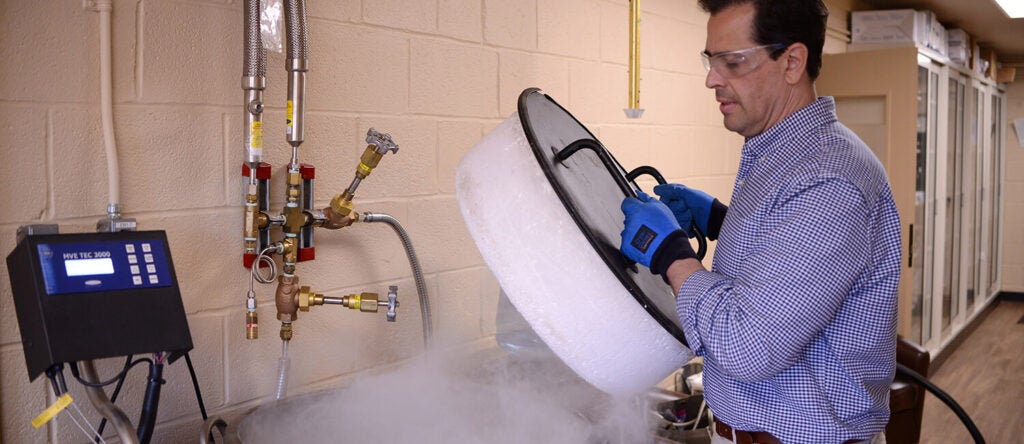
Sperm are frozen in small, 0.5 ml plastic straws labelled with the stallion’s name and breed as well as the date of the freeze. Typically, four-eight straws are used to make one breeding dose. The straws are stored in liquid nitrogen at ( -)180 degrees centigrade and, if properly stored, should be preserved indefinitely.
Mares bred with frozen semen have to managed more carefully than mares bred with cooled or fresh semen because they need to be bred very close to the time of ovulation.
Mare owners should be sure that the veterinarian working with the mare is familiar with the use of frozen semen.
Mares can be managed and bred here at New Bolton or the frozen straws can be shipped anywhere in the United States in special liquid nitrogen shipping tanks to breed mares offsite. The straws are thawed immediately prior to inseminating the mare.
This varies tremendously depending on the innate fertility of your stallion. More mature stallions with larger testicles typically will produce more breeding doses than younger colts with smaller testicles. An average adult stallion (over 3 or 4 years of age) can produce 20 to 40 breeding doses or more.
Again, this will vary depending on the innate fertility of your stallion. However, recent studies, including a study performed at New Bolton Center, have shown that pregnancy rates with good quality frozen epididymal sperm are no different than those achieved with sperm frozen by more conventional means (e.g. where semen is collected from an intact stallion and frozen). In fact, in many cases, pregnancy rates are similar to those obtained with fresh, cooled semen. We cannot guarantee the fertility of frozen epididymal sperm from your stallion/gelding, but we will keep you posted during each step of the freezing process so that you can make an informed decision as to whether or not you want to continue with the freeze, depending on how the sample holds up during processing.


