Sports Medicine
What we do
The Sports Medicine Service at New Bolton Center is a team of specialists committed to the thorough evaluation, diagnosis, and treatment of equine athletes. We aim to provide precise diagnoses and develop targeted treatment plans tailored to each horse’s specific needs. We offer a comprehensive range of therapies for injuries and other performance related issues, all with the goal of safely restoring your horse to peak performance following injury or illness.
Our Services
Procedures and Treatment
We offer a wide range of diagnostic modalities and treatment options tailored to meet the unique needs of your horse. We collaborate with other specialized services at New Bolton Center, including internal medicine, neurology, diagnostic imaging, surgery and cardiology, to ensure comprehensive and coordinated care. This integrated approach allows us to provide the most effective and personalized treatment plans, ensuring the best possible outcomes for your horse. To make an appointment, call (610) 925-6190 or (610) 925-6140.
Lameness Evaluation
Sports Medicine clinicians at New Bolton Center specialize in the evaluation, diagnosis, and treatment of lameness in horses. Evaluation begins with a thorough physical examination focused on the musculoskeletal system, followed by detailed gait assessment (lameness examination) on multiple surfaces. We use a full complement of diagnostics including palpation, evaluation in hand and on the lunge, comprehensive nerve/joint blocks and objective lameness assessments (such as the Equinosis Lameness Locator®) when necessary. Evaluation during ridden evaluation is encouraged, allowing our clinicians to accurately assess performance related problems that are only present or exacerbated under saddle. A full complement of imaging is also available including radiology, ultrasound, MRI, computed tomography (CT), nuclear medicine (bone scan), and PET scan imaging.
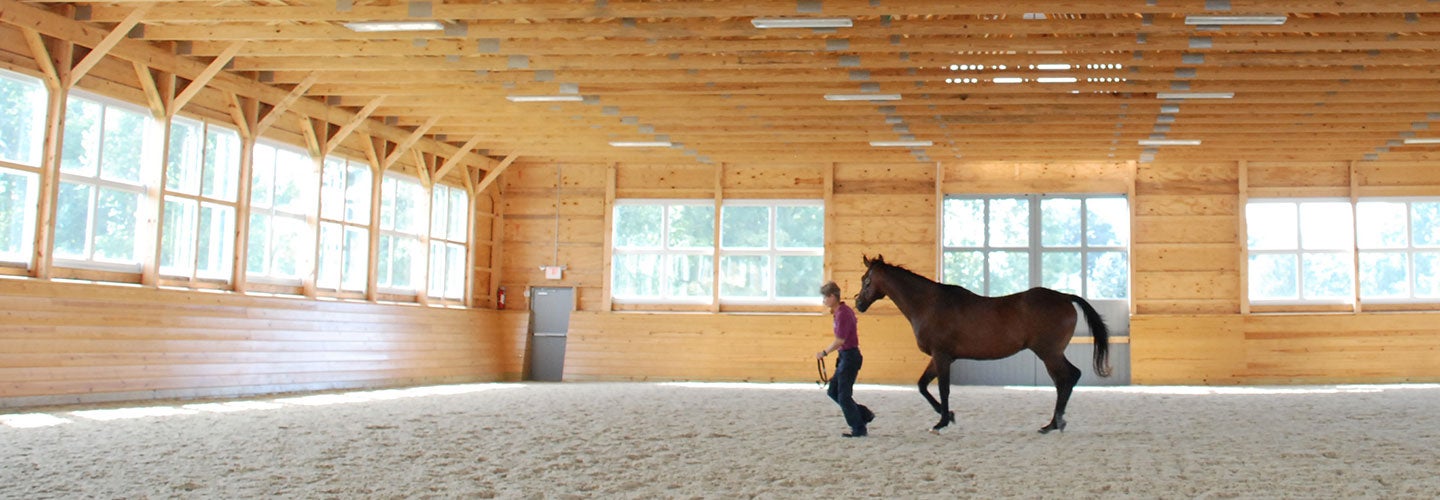
Lameness, gait, and exercising evaluations are performed in our indoor arena, the Ilona English Equine Performance and Evaluation Facility (EPEF). This 80-foot by 120-foot arena is airy, comfortable and flooded with natural light from large windows. The indoor arena footing is an all-weather footing, MC Ecotrack®, which proves a consistent and level surface that is familiar to equine athletes. This facility is a valuable asset to the entire sports medicine team, including clinicians, clients, students, and most importantly, our patients.
Pre-Purchase Examination
The goal of a pre-purchase exam is to assess the horse’s overall health, soundness, and suitability for intended use, helping buyers to make informed decisions before completing a purchase. For pre-purchase exams, we offer comprehensive diagnostics including thorough physical examination, gait evaluation and imaging, including radiographic evaluation of the back and neck. Evaluations are tailored to the individual horse, the needs of the client, and athletic goals. Additional diagnostics available include ultrasonography, upper airway endoscopy, cardiac and neurologic assessment, drug screening and blood analysis.
Poor Performance Examination
It can be incredibly frustrating and disheartening to have a horse with poor performance and no clear explanation, leaving owners and riders feeling helpless and uncertain about the next steps. Our Sports Medicine team has extensive experience evaluating horses with poor performance and we take a thorough, multidisciplinary approach to identify the underlying causes of these issues. Horses with complex performance problems may require evaluations from our internal medicine, neurology, behavior, reproduction, surgery and cardiology services, and we work diligently to ensure comprehensive and coordinated diagnostics, often within the same day of the appointment. This integrated approach allows us to provide the most effective and personalized diagnostic and treatment plans, ensuring the best possible outcomes for your horse.
Imaging (Radiography, Ultrasonography, CT, MRI, Nuclear Scintigraphy, PET Scan)
The sports medicine team works closely with the board-certified diagnostic imaging team. We have a full complement of imaging modalities including radiography, ultrasound, nuclear medicine (bone scan), and advanced imaging (MRI, CT, and PET scan). Our equipment is capable of imaging the neck, back, pelvis, and shoulder of the horse. We also provide standing CT imaging, equine PET (Positron Emission Tomography), bone scans, and MRI. Learn more about the services that Diagnostic Imaging offers.
High-Speed Treadmill Assessment and Endoscopy
For horses that compete at high speeds, evaluation at rest can often underestimate or miss the cause of decreased performance, particularly for horses with respiratory or cardiac issues. High-speed treadmill examinations allow us to evaluate your horse while trotting, pacing, cantering or galloping, providing the most accurate insight into the source of their performance issues. During evaluation, our Sports Medicine team can assess multiple body systems at once, such as the heart, upper airway, lungs, and musculoskeletal system at high speeds.
Our high-speed treadmill can reach speeds of up to 45 miles per hour, which makes it ideal for evaluating racehorses. It can be used for sport horses, draft horses, and ponies—any horse that needs assessment while exercising. Various equipment can be applied to the horse while exercising on the treadmill so that multiple body systems can be evaluated at one time. Treadmill evaluation can be completed on an outpatient basis and the typical appointment lasts 5-8 hours.
What Treadmill Testing Includes
- Exercising upper airway endoscopy
- Exercising electrocardiogram (ECG), to measure heart rate and rhythm
- Echocardiogram, an ultrasound of the heart
- Arterial blood gas analysis
- Bronchoalveolar lavage (BAL), fluid analysis from the lungs
- Electrolyte, muscle enzyme, and lactate analysis
Horses should be sound and fit, preferably training at the level during which the performance problem(s) occurs. To exercise on the treadmill, horses must be shod with four flat shoes (no toe grabs, heel caulks, or borium). Where appropriate, please bring your horse’s harness or other tack. Please bring details of previous examinations, imaging and treatments with you to the appointment.
Overground Endoscopy
The function of the horse’s upper airway can change dramatically when exercising or ridden, making resting evaluation inaccurate at times. We offer wireless overground endoscopy to assess the horse’s upper airway function during exercise, greatly improving our ability to identify performance limiting issues. Testing can be performed in any exercising horse, either in the hospital or at your farm or at the track. After diagnosis, our clinicians are able to provide targeted treatment options, often including surgical therapies.
Cardiology
Cardiac arrhythmias and murmurs are common in the athletic horse. Our team can assist with the cardiac assessment including echocardiogram (ultrasound of the heart) and exercising cardiac evaluation. We specialize in assessing the implications of heart conditions for your horse’s specific needs and in a pre-purchase examination. Find out more about the Cardiology service.
Regenerative Medicine (PRP, APS, Stem Cell)
Numerous regenerative therapies are available at New Bolton Center which can be integrated into your horse’s post injury treatment. We provide onsite platelet rich plasma (PRP), autologous protein solution (APS, Pro-Stride) and autologous stem cell therapy. Under FDA approval, we are able to harvest your horse’s bone marrow for autologous stem cell culture in the Ortved Orthopedic Regenerative Medicine Laboratory, and store these cells for management of future injury.
Additional Therapies
We offer a variety of targeted therapies aimed at treating musculoskeletal injury, including joint injections and advanced ultrasound-guided injections (including intra-lesional injections for tendon and ligament injury, cervical facet and cervical nerve root injections, sacroiliac injections, and back injections).
Rehabilitation
At New Bolton Center, we feel that rehabilitation after injury is crucial for injured horses as it promotes proper healing, restores strength and function, and helps prevent re-injury, ensuring a safe and successful return to work. Our boarded Sports Medicine and Rehabilitation specialists are available to create customized, injury-specific rehabilitation protocols tailored to your horse’s needs. As we design and implement these treatment plans, we incorporate a range of advanced therapeutic modalities available at our facility, such as shockwave therapy, therapeutic ultrasound, TENS (transcutaneous electrical nerve stimulation), NMES (neuromuscular electrical stimulation), Equiband elastic resistance band systems, and balance pads. We also collaborate closely with referring veterinarians, trainers, and owners to deliver practical, effective, and farm-friendly rehabilitation solutions.
Our Care Team

Sports medicine, service chief
Elizabeth J. Davidson, DVM, DACVS, DACVSMR
Professor of Equine Sports Medicine (CE)
Clinicians




Resident