
Vision Scientists at Penn Vet Launch DogAEye, a Novel AI-Based Tool To Improve Early Diagnosis of Retinal Degeneration in Dogs

Veterinary ophthalmologists and vision scientists at the University of Pennsylvania’s School of Veterinary Medicine (Penn Vet) have announced the release of DogAEye, an innovative artificial intelligence (AI)–based clinical decision support tool to assist veterinarians in the early detection of progressive retinal atrophy (PRA), a leading cause of blindness in dogs.
“Progressive retinal atrophy (PRA) encompasses a diverse group of inherited retinal degenerations affecting more than 100 dog breeds. These conditions lead to gradual, irreversible vision loss,” said William A. Beltran,DVM, PhD, DECVO, the Corinne R. and Henry Bower Professor of Ophthalmology, and director of the Division of Experimental Retinal Therapies. “Early retinal changes are subtle and easily missed, resulting in diagnoses that typically occur only after significant disease progression.”
DogAEye was developed to bridge this critical diagnostic gap.
AI-Powered Support for Earlier, More Confident Diagnoses
Through its simple web interface, veterinarians can securely upload fundus photographs from the animals’ eyes along with information about the pet. DogAEye then applies a deep learning classifier, an algorithm used to assign a label to vast amounts of data. This robust data set enables DogAEye to identify the earliest structural changes associated with PRA; changes that may not be visible during a routine examination. A report summarizes the findings for inclusion in the pet’s medical record and for communication with owners.
“By delivering rapid assessments at the point of care, DogAEye is designed to improve earlier recognition of the disease,” said Beltran. “With this type of AI-based tool, we expect that in the future, veterinarians in general practice could be the ones taking fundus photographs to detect suspicious cases of PRA before referring them to veterinary ophthalmologists for final diagnosis, prognosis, and therapeutic options.”
By enabling the identification of PRA at an earlier stage, DogAEye represents a significant step forward in companion animal ophthalmology.
“In validation studies, DogAEye outperformed a panel of board-certified veterinary ophthalmologists in detecting early-stage PRA,” said David Smith, a research specialist in the Beltran Lab who worked on developing DogAEye.

Advancing Vision Health for Dogs Everywhere
Penn Vet also opened the Retinal Health Clinic in November 2024, a sub-specialty clinic at Ryan Hospital led by Assistant Professor of Translational Ophthalmology Valerie Dufour, DVM, DACVO, DECVO, that is dedicated to supporting companion animals affected by PRA and informing owners about the disease, its diagnosis, and progression. Beltran hopes that together, these two major initiatives will improve outcomes for affected breeds and bolster ongoing research into retinal disease and potential therapies.
For veterinarians interested in exploring the DogAEye interface, click here. For pet owners interested in learning more about Ryan Hospital’s Retinal Health Clinic, go here.
Related News

Penn Vet Announces Fourth Annual Symposium on Zoonotic Disease Research
The Institute for Infectious and Zoonotic Diseases (IIZD) at the University of Pennsylvania’s School of Veterinary Medicine (Penn Vet) has announced the agenda for its 2026 IIZD Symposium. The event…
Penn Vet Researchers Uncover a Shared Cellular Stress Signal that May Drive Vision Loss in Retinitis Pigmentosa
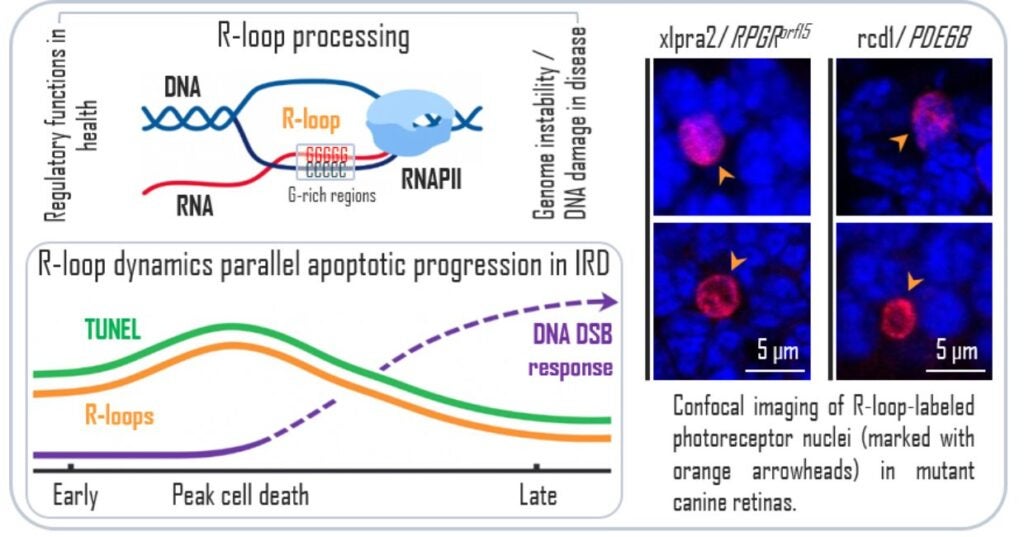
Study finds buildup of unusual RNA-DNA loops in degenerating photoreceptors, pointing to a shared molecular stress pathway across distinct genetic forms of inherited blindness.

Behind the Breakthroughs: David Holt
In this edition, we sit down with small animal Professor of Surgery, David Holt, BVSc, DACVS. Dr. Holt is redefining how cancer is seen and removed during surgery. A Diplomate…
About Penn Vet
Ranked among the top ten veterinary schools worldwide, the University of Pennsylvania School of Veterinary Medicine (Penn Vet) is a global leader in veterinary education, research, and clinical care. Founded in 1884, Penn Vet is the first veterinary school developed in association with a medical school. The school is a proud member of the One Health initiative, linking human, animal, and environmental health.
Penn Vet serves a diverse population of animals at its two campuses, which include extensive diagnostic and research laboratories. Ryan Hospital in Philadelphia provides care for dogs, cats, and other domestic/companion animals, handling more than 30,000 patient visits a year. New Bolton Center, Penn Vet’s large-animal hospital on nearly 700 acres in rural Kennett Square, PA, cares for horses and livestock/farm animals. The hospital handles more than 6,300 patient visits a year, while our Field Services have gone out on more than 5,500 farm service calls, treating some 22,400 patients at local farms. In addition, New Bolton Center’s campus includes a swine center, working dairy, and poultry unit that provide valuable research for the agriculture industry.