
Penn Vet Scientist Receives Grant to Study Unconventional T Cell Response to Advance Potential HIV/AIDS Vaccine Development
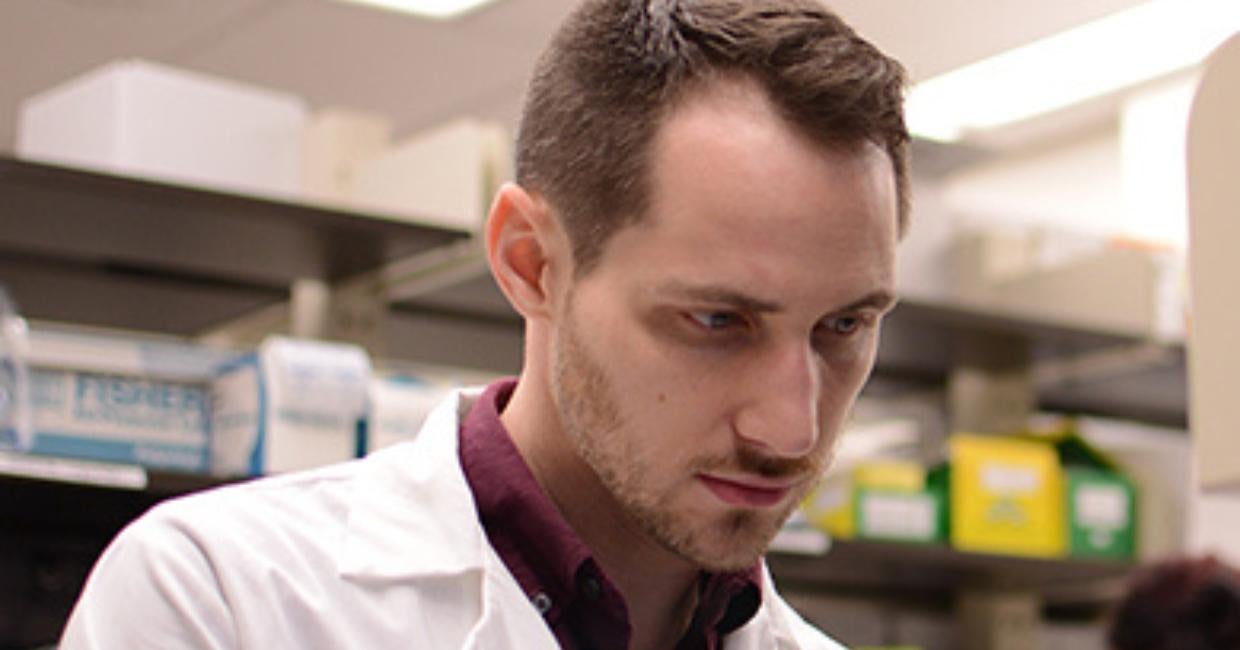

Michael J. Hogan, PhD, assistant professor of Pathobiology at the University of Pennsylvania School of Veterinary Medicine (Penn Vet), has been awarded a one-year grant from the W.W. Smith Charitable Trust. The grant will fund Hogan’s investigation aimed at gaining a clearer understanding of a particular type of immune response that could pave the way for developing a safe and effective HIV/AIDS vaccine using pioneering mRNA technology.
A viral immunologist and vaccinologist, Hogan’s research focuses on understanding how immune systems defend against viruses. He studies animal and human immune cell response to harmful pathogens with the goal of generating various mRNA vaccine designs to protect against infection. Hogan’s work has appeared in Nature, Nature Immunology, Annual Reviews of Medicine, and Immunity.
Hogan joined Penn Vet in January 2024. He serves on the faculty of Penn’s interdisciplinary graduate program, the Cell and Molecular Biology Graduate Group, where he supports the Gene Therapy and Vaccines and the Microbiology, Virology, and Parasitology areas of study. Hogan is also a member of the Perelman School of Medicine’s Penn Center for AIDS Research. He earned his PhD in Cell and Molecular Biology from the University of Pennsylvania (Penn). Hogan trained in the Penn laboratories of Drew Weissman, MD, PhD, and James Hoxie, MD; and completed his postdoctoral work in the laboratory of Laurence “Ike” Eisenlohr, VMD, PhD, at the Children’s Hospital of Philadelphia.
The W.W. Smith Charitable Trust funds unique and meritorious medical research in the Philadelphia metropolitan region related to heart disease, cancer, and AIDS. Research proposals are peer reviewed by a medical advisory committee and funding is awarded to proposals capable of having a direct influence on the fight against these degenerative diseases. Since its inception in 1977, the W.W. Smith Charitable Trust has awarded over $82 million in medical research grants.
Learn more about about Penn’s AIDS research in Penn Today.
Related News

Penn Vet Welcomes Dr. Oyebola Oyesola as Presidential Assistant Professor and Leader in Immunology and Infectious Disease Research
The School of Veterinary Medicine at the University of Pennsylvania (Penn Vet) has announced the appointment of Oyebola Oyesola, DVM, PhD, as a faculty member and University-designated Presidential Assistant Professor…

Penn Vet’s Dean Andrew Hoffman Highlights Vaccination, Veterinary Support in Fight Against Highly Pathogenic Avian Influenza
As Pennsylvania confronts its largest avian influenza outbreak in years, the University of Pennsylvania School of Veterinary Medicine’s (Penn Vet) Gilbert S. Kahn Dean of Veterinary Medicine, Andrew M. Hoffman,…

Penn Vet Scientists Earn National Honors for Breakthrough Research in Virology and Cancer Innovation
Louise Moncla, PhD, receives Ann Palmenberg Junior Investigator Award; Timour Baslan, PhD, named 2026 Damon Runyon–Rachleff Innovation Award recipient
About Penn Vet
Ranked among the top ten veterinary schools worldwide, the University of Pennsylvania School of Veterinary Medicine (Penn Vet) is a global leader in veterinary education, research, and clinical care. Founded in 1884, Penn Vet is the first veterinary school developed in association with a medical school. The school is a proud member of the One Health initiative, linking human, animal, and environmental health.
Penn Vet serves a diverse population of animals at its two campuses, which include extensive diagnostic and research laboratories. Ryan Hospital in Philadelphia provides care for dogs, cats, and other domestic/companion animals, handling more than 30,000 patient visits a year. New Bolton Center, Penn Vet’s large-animal hospital on nearly 700 acres in rural Kennett Square, PA, cares for horses and livestock/farm animals. The hospital handles more than 6,300 patient visits a year, while our Field Services have gone out on more than 5,500 farm service calls, treating some 22,400 patients at local farms. In addition, New Bolton Center’s campus includes a swine center, working dairy, and poultry unit that provide valuable research for the agriculture industry.