
Penn Vet’s Nicola Mason, BVetMed, PhD, DACVIM, FRCVS, Receives Penn Center for Innovation’s Inventor of the Year Award
Dr. Nicola “Nicky” Mason recognized for advancements in veterinary immunotherapy
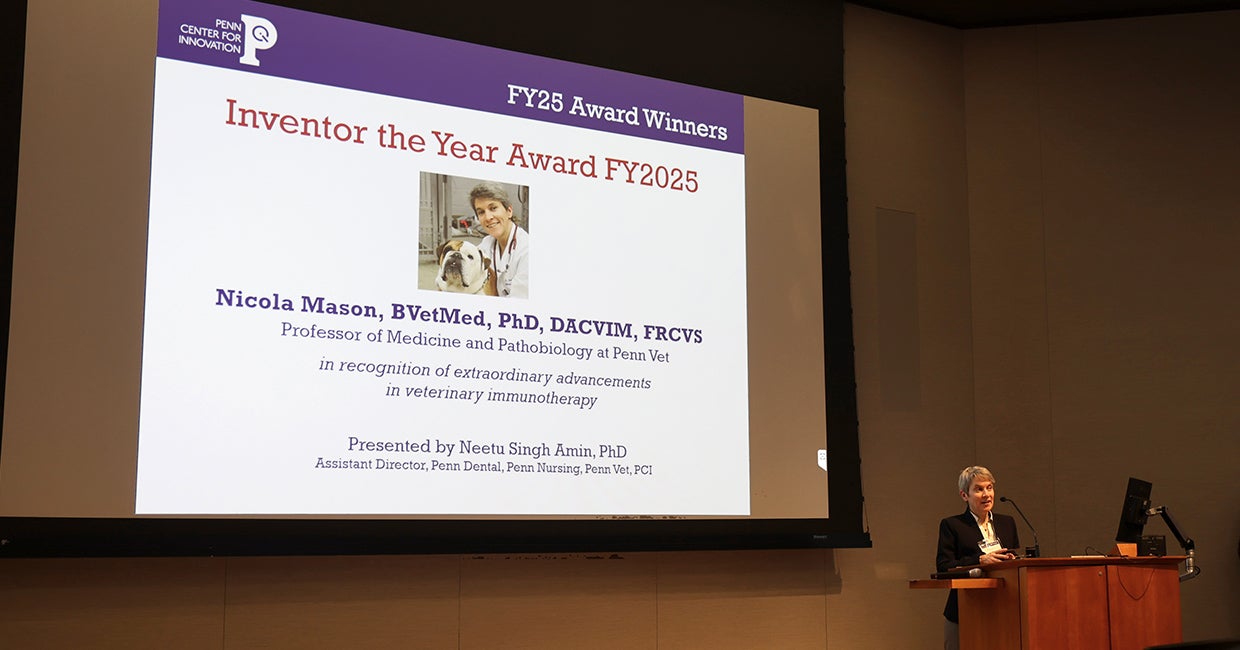
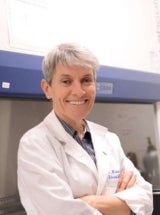
The University of Pennsylvania (Penn) School of Veterinary Medicine (Penn Vet) congratulates Dr. Nicky Mason, the Paul A. James and Charles A. Gilmore Endowed Chair Professor and Professor of Medicine and Pathobiology, for winning the Penn Center for Innovation’s (PCI) distinguished 2025 Inventor of the Year Award. Mason was presented with the award on December 2, 2025, at PCI’s 10th annual Celebration of Innovation at the Perelman Center for Advanced Medicine. She was one of the evening’s five celebrated awardees.
The University of Pennsylvania’s Vice Provost of Research, David F. Meaney, PhD, who delivered keynote remarks, emphasized the University’s dual responsibility not only to advance faculty discovery but also to champion the transformation of those discoveries into real-world applications. Highlighting Penn’s exceptional record of 46 FDA-approved drugs and devices in the past decade, he underscored the University’s unique strength in translating innovation into impact. He noted that while Penn’s traditional tripartite mission centers on education, discovery, and service, it is now expanding to embrace a fourth purpose: putting ideas into practice in ways that build the economy of the surrounding region.
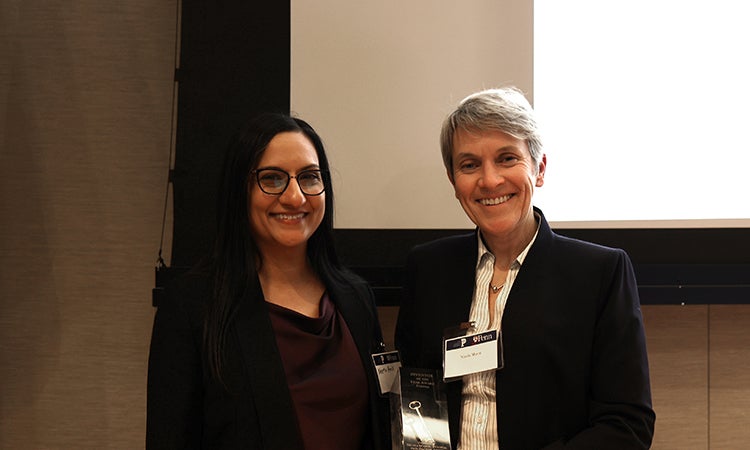
PCI’s Neetu Singh Amin, PhD, who presented Mason with the award, highlighted Mason’s exceptional productivity and impact as an innovator, noting her 27 invention disclosures, 23 patent filings, two veterinary clinical trial agreements, and 17 full license agreements and amendments. Amin praised Mason’s collaborative spirit, emphasizing that Mason “is a brilliant veterinarian and professor, and a true innovator who is transforming veterinary and human medicine alike.”
“This is an incredible honor. It is an amazing feeling to be in this group of innovators and inventors,” said Mason. “Nothing is invented in a vacuum. There are numerous collaborators, colleagues, and support systems that helped bring these ideas and innovations across the finish line into the veterinary space and then into the pediatric space. I am humbled, and so very thankful.”
Mason propels next-generation immunotherapy
Mason’s translational research employs a comparative approach to accelerate the clinical implementation of effective immunotherapies, including engineered T and iNKT cells, as well as monoclonal antibodies, for both canine and human patients with cancer and autoimmune diseases. She leads the NIH/NCI-supported pre-medical cancer immunotherapy network for canine trials, comprising veterinary and medical clinician scientists, who perform clinical trials in dogs with naturally occurring cancers to speed the development of new immunotherapies and identify correlative biomarkers of response, informing both human and canine drug development. In 2017, Mason co-founded Vetigenics, a biotech company that develops antibodies and antibody-targeted approaches for pets with cancer and other chronic diseases. Together with Vetigenics, she has brought two canine checkpoint inhibitors into the veterinary clinic and has multiple other antibody-based therapeutics in development for inflammatory and allergic indications. In 2024, she launched the revolutionary Comparative Immunology Program at Penn Vet, which bridges human and veterinary medicine with the goal of advancing the most promising immunotherapies to benefit both species.
Mason is the recipient of the Royal Kennel Club’s 2024 International Canine Health Award, and she was recently installed as a Fellow of the Royal College of Veterinary Surgeons in recognition of her “meritorious contributions to knowledge in the veterinary profession.” She was featured in the Daytime Emmy-nominated PBS documentary “Shelter Me: The Cancer Pioneers” and has appeared in numerous print and broadcast media outlets, including “60 Minutes” with Anderson Cooper.
A graduate of London’s Royal Veterinary College, Mason performed her internship at the University of Bristol and her internal medicine residency at the University of Pennsylvania. She also received her PhD in Immunology from the University of Pennsylvania and performed a postdoctoral fellowship in cancer immunotherapy at the Abramson Cancer Center.
Past winners of the Inventor of the Year Award have included Nobel Prize Winners Drew Weissman, MD, PhD, and Katalin Karikó, PhD; Penn Vet’s William Beltran, DVM, PhD, and Gustavo “Gus” Aguirre, VMD, PhD, for their work developing therapies to treat inherited retinal disorders; and Mason’s very first collaborator, the Perelman School of Medicine’s Yvonne J. Paterson, PhD, who developed a listeria-based immunotherapy to fight tumors.
Penn Vet innovators are also recognized as Penn secures 99 new patents, top national ranking
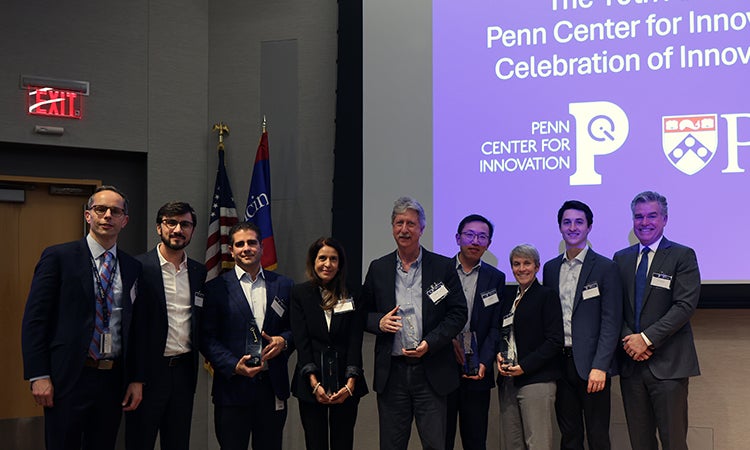
PCI also recognized the six Penn Vet inventors who received patents during the previous year: Darko Stefanovski, PhD; Nicky Mason, BVetMed, PhD; Ellen Puré, PhD, and Leslie Hopper; and William Beltran, DVM, PhD, and Gustavo “Gus” Aguirre, VMD, PhD. Each patent awardee received a personalized “patent cube” to mark their achievement. Ninety-nine new patents were awarded to Penn faculty by the U.S. Patent and Trademark Office for the year ending June 30, 2025. According to the National Academy of Inventors, the University of Pennsylvania ranks among the top 15 U.S. universities granted patents in 2024.
“None of these accomplishments or successes would be possible without the incredible ideas, discoveries, and inventions generated every day by the faculty and other innovators across Penn,” said PCI Managing Director and Associate Vice Provost Benjamin Dibling, PhD. “They are truly our most valued partners.”
For more information about the Penn Center for Innovation, read here.
Related News
Penn Vet’s Total Hip Replacement Program Helps Heal Dogs With Hip Dysplasia So They Can Live ‘Their Best Lives’
Stephanie and Michael Fullmer fell in love with Cora, a sweet-natured rescue Golden Retriever, as soon as they saw her photo. And Cora loved back – kids, kittens, other dogs,…
New Bolton Center Surgeons Come Through for Howee the Steer and his Girl
Mallie Touchton was always a farm animal kid. Since she was 8, Mallie was raising and showing her own market livestock – pigs, goats, and dairy calves. Even though she…
Behind the Breakthroughs: Amy Johnson
Balancing clinical care with scientific inquiry, Penn Vet’s Amy Johnson leads efforts to decode the complexities of neurologic diseases in horses
About Penn Vet
Ranked among the top ten veterinary schools worldwide, the University of Pennsylvania School of Veterinary Medicine (Penn Vet) is a global leader in veterinary education, research, and clinical care. Founded in 1884, Penn Vet is the first veterinary school developed in association with a medical school. The school is a proud member of the One Health initiative, linking human, animal, and environmental health.
Penn Vet serves a diverse population of animals at its two campuses, which include extensive diagnostic and research laboratories. Ryan Hospital in Philadelphia provides care for dogs, cats, and other domestic/companion animals, handling more than 30,000 patient visits a year. New Bolton Center, Penn Vet’s large-animal hospital on nearly 700 acres in rural Kennett Square, PA, cares for horses and livestock/farm animals. The hospital handles more than 6,300 patient visits a year, while our Field Services have gone out on more than 5,500 farm service calls, treating some 22,400 patients at local farms. In addition, New Bolton Center’s campus includes a swine center, working dairy, and poultry unit that provide valuable research for the agriculture industry.