
Penn Vet’s Total Hip Replacement Program Helps Heal Dogs With Hip Dysplasia So They Can Live ‘Their Best Lives’
Faculty In This Story


Sometimes you just can’t turn down a face.
Stephanie and Michael Fullmer fell in love with Cora, a sweet-natured rescue Golden Retriever, as soon as they saw her photo. And Cora loved back – kids, kittens, other dogs, even the toys she stockpiled in her crate, little stand-ins for all the litters taken from her as a puppy mill breeder dog.
The Fullmers were given other information about Cora, too.
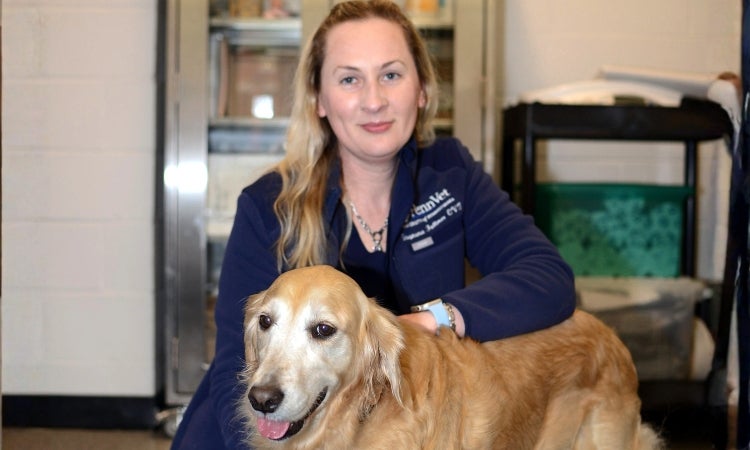
“We knew she had severe hip dysplasia, and she would need care the rest of her life. We felt we were in a situation that we could give her that,” said Stephanie, at the time a veterinary nurse for a private practice.
But soon it became apparent that Cora’s dysplasia, even though she was only two years old, was far worse than they had thought.
“She didn’t want to walk,” Stephanie said. “She was panting a lot when she would go on any kind of even short walks, indicating she was in a lot of pain. She laid down a lot. She didn’t want to walk up steps. She was very stiff, and she put most of her weight on the front half of her body to take the weight off her back legs. It was pretty clear that trying just medical management wasn’t going to be enough for her.”
So the Fullmers turned to Penn Vet, hoping for something that could help Cora.
Today, Cora’s a different dog. She plays, she swims, she goes bounding down trails like Goldens are born to do. Best of all, she does it without pain.
Cora became a patient in Penn Vet’s Total Hip Replacement Program (THRP). She had surgery on her left hip and a few months later on her right hip, too.
The life-changing impact on this young Golden Retriever was made possible by a type of surgery that isn’t new but whose outcomes have been greatly improved through state-of-the-art technological advances and synergistic programming.
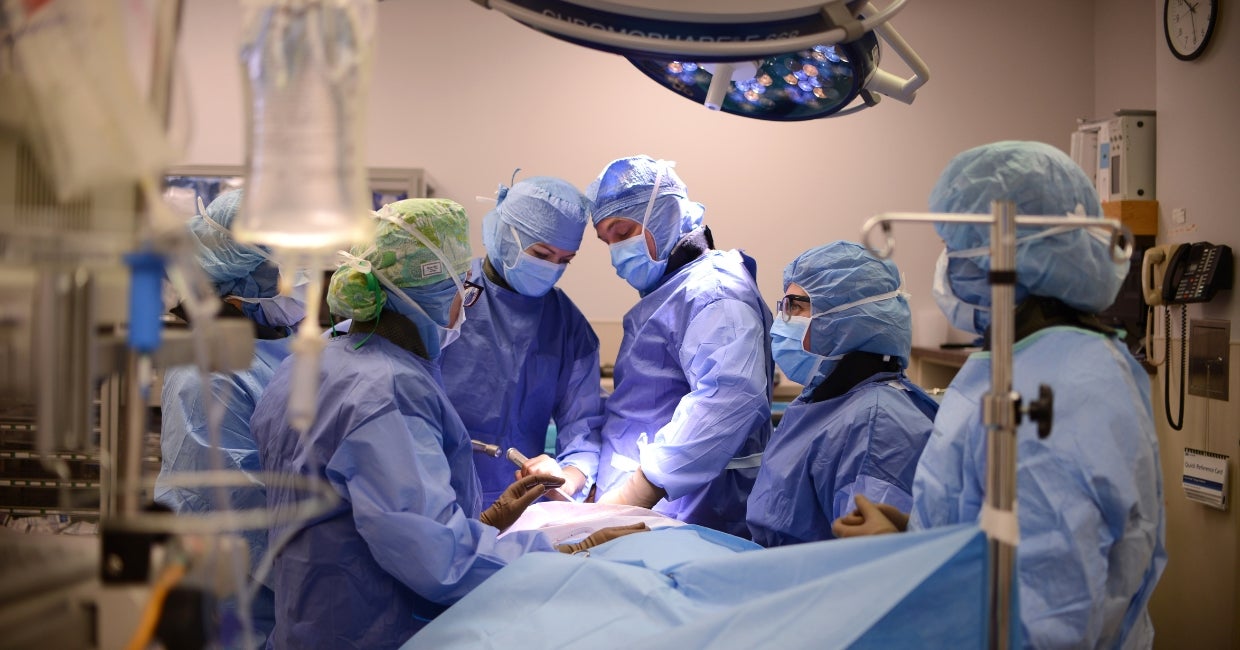
“What’s happened is we’ve refined the procedure working together as a team,” said Kimberly Agnello, professor of small animal orthopedic surgery, who leads the THRP with Jason Syrcle, Section Chief and professor of clinical small animal orthopedic surgery. “We’re in every surgery together,” working with a set cadre of nurses.
Teamwork plus technological advances enable better patient outcomes
The Penn Vet team notes that adopting the latest advances in their core procedures has also led to better outcomes for their patients.
During surgeries, the THRP team utilizes intraoperative fluoroscopy, a medical imaging technique that employs a mobile X-ray machine, known as a C-arm, to provide real-time, moving images during their procedures. This enables surgeons to visualize internal structures and guide instruments or implants, such as those used in total hip replacements, with greater precision.
With that kind of precision comes a decreased risk of complications and a lower likelihood of future surgeries, according to Agnello.
“If we can get it right the first time, we find those patients have the best prognosis for doing well,” she said.
Total hip replacements can require either of two types of implant systems: one that uses bone cement and the newer type that is cementless. Syrcle said while there are cases where cement implants may be appropriate, their team tends to use the cementless implants.
“As dogs get older, you can have some long-term issues with cement,” including degradation and loosening, “whereas with the cementless implants, they actually get stronger over time,” Syrcle said.
In addition, the THRP surgeons operate on some dogs with particularly complicated hip structures or very abnormal joints and bones due to trauma, said Agnello. In those cases, she said they can print a three-dimensional model of a specific dog’s hips, created from CT scans, and use the printed model to practice on before the actual surgery.
The program’s literature notes that middle-aged to older large-breed dogs with hip dysplasia that are not responsive to medical management are the classic candidates for total hip replacement. But the Penn Vet program now considers much younger dogs for treatment, due to advances in hip replacement technology. This includes dogs as young as 10 months old, and even younger in select cases.
The doctors say some of the young hip dysplasia cases they see are the result of bad breeding practices, such as puppy mill breeding. Since the lifespan of hip implants is often about 15 years, about the same as many dogs’ lifespan, one of their surgeries is likely to last a dog’s whole life, according to Agnello.
“Years ago, we might have kept waiting,” she said. “They lose more muscle mass, they lose more range of motion. If we can get it in sooner, it’s actually better for the whole limb.”
Total hip replacement surgery can be the alternative to a painfully limited life or even no life at all.
“Some of these dogs without this procedure would have faced seriously curtailed activity or euthanasia at some point,” Syrcle said. “A lot of our cases have very dramatic results.”
Two Golden Retrievers, two changed dog lives
Cora’s hip replacement surgeries – she had both hips done two months apart – went better than the Fullmers might have even hoped. The day of her first surgery – her left hip – she was already able to walk on that leg. If anything, they had to take steps to slow her down so she could get the necessary three months of healing time in.
The following year, the Fullmers adopted Piper from Zoe’s House, the same rescue where they found Cora. Like Cora, Piper had been used for breeding in a puppy mill, and it turned out she also had hip dysplasia, more serious than the Fullmers had first thought. In spring 2024, she also had total hip replacement surgery.
It’s easier for Stephanie Fullmer to take her dogs for their check-ups now; earlier this year, she joined the Penn Vet clinical staff and is nurse coordinator for the Orthopedic Surgery Service. Her work includes the THRP.
Its alumnae Cora and Piper have the same sunny Golden personalities they always did, but now they’ve got the energy to match.
“We take them on long walks with no issues. At this point, they don’t have any restrictions,” Stephanie said. “I obviously don’t want them jumping off a cliff or something like that, but everything has healed nicely. They do come back every year to get X-rays to make sure everything looks OK with the implants. They’re both running around and playing with each other and taking long walks and never showing any signs of discomfort or anything like that.
“They’re living their best lives.”
Related News
Behind the Breakthroughs: David Holt
In this edition, we sit down with small animal Professor of Surgery, David Holt, BVSc, DACVS. Dr. Holt is redefining how cancer is seen and removed during surgery. A Diplomate…

Annual Penn Vet Clinic Delivers Preventive Care to Hundreds of Philadelphia Pets
The Ryan Hospital at the University of Pennsylvania’s School of Veterinary Medicine (Penn Vet) hosted the 16th annual Dog and Cat Wellness and Vaccination Clinic on the Martin Luther King,…

At the 110th Pennsylvania Farm Show, Penn Vet and Agriculture Make For A Winning Partnership. And Don’t Forget the Milkshakes.
Just as Penn Vet has been a partner in Pennsylvania agriculture since its founding in 1884, the School has been an integral part of the Pennsylvania Farm Show. At this…
About Penn Vet
Ranked among the top ten veterinary schools worldwide, the University of Pennsylvania School of Veterinary Medicine (Penn Vet) is a global leader in veterinary education, research, and clinical care. Founded in 1884, Penn Vet is the first veterinary school developed in association with a medical school. The school is a proud member of the One Health initiative, linking human, animal, and environmental health.
Penn Vet serves a diverse population of animals at its two campuses, which include extensive diagnostic and research laboratories. Ryan Hospital in Philadelphia provides care for dogs, cats, and other domestic/companion animals, handling more than 30,000 patient visits a year. New Bolton Center, Penn Vet’s large-animal hospital on nearly 700 acres in rural Kennett Square, PA, cares for horses and livestock/farm animals. The hospital handles more than 6,300 patient visits a year, while our Field Services have gone out on more than 5,500 farm service calls, treating some 22,400 patients at local farms. In addition, New Bolton Center’s campus includes a swine center, working dairy, and poultry unit that provide valuable research for the agriculture industry.