
Research Events
Each year, the Penn Vet research community comes together for two cornerstone events — the Research Retreat and Student Research Day — designed to showcase discovery, foster connection, and celebrate student and faculty scholarship.
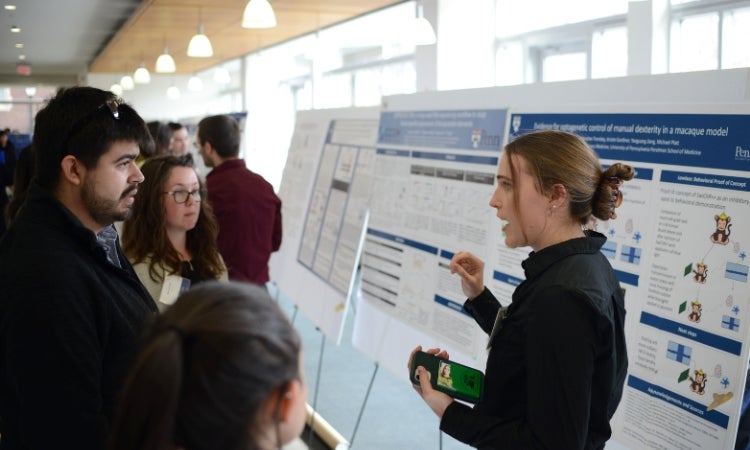
Student Research Day
Abstract Submission Deadline: Monday, February 1, 2027
Registration Deadline: Friday, March 12, 2027
Friday, March 26, 2027
Time: 11:15 AM – 6:00 PM (tentative)
Location: Vernon and Shirley Hill Pavilion
KEYNOTE
The Class of 1966 Endowed Lecture
Erika Ganda, DVM, PhD
From Dairy Medicine to Global Antimicrobial Resistance Research
Abstract
Few veterinary students picture themselves running a sequencing pipeline or designing a surveillance study across three continents. This talk traces Dr. Ganda’s path from a dairy production medicine and consulting training to a research program investigating how antimicrobial resistance emerges, persists, and moves through food animal systems worldwide.
The lecture will cover the science behind that trajectory. Genomic surveillance of Salmonella Dublin in Pennsylvania dairy herds has revealed transmission patterns that herd-level epidemiology alone could not explain, with direct implications for how veterinarians advise producers. Resistome profiling in poultry production has shown how the resistance gene pool responds to management changes, including the shift toward antibiotic alternatives. Collaborative work in Kenya, Brazil, and India has demonstrated that resistance is a shared global problem with locally specific solutions.
The through line is that clinical training is not a detour from research. The questions worth asking in a laboratory are often the ones that first surfaced in a barn, and the veterinary perspective, comfort with messy field systems, attention to animal health as a production reality, and credibility with producers, is an asset the resistance field needs more of.
The talk will close with reflections on building a scientific career that does not follow a template..
About Dr. Ganda
Erika Ganda, DVM, PhD, is a veterinarian and the Dorothy Foehr Huck and J. Lloyd Huck Chair in Global Antimicrobial Resistance and Associate Professor of Food Animal Microbiomes at Penn State University. She serves on the executive committee of the One Health Microbiome Center and co-convenes the SAFES Sustainable Livestock Systems Critical Issue Initiative. Her research group studies resistance dynamics in food animal microbiomes. She integrates genomic surveillance, microbiome science, and field epidemiology to track pathogen transmission and AMR emergence across dairy and poultry systems, with emphasis on Salmonella Dublin. Her research spans the animal-human-environment interface and includes collaborations across Africa, South Asia, and Latin America. Dr. Ganda holds a DVM from the Federal University of Goiás and a PhD in Animal Science from Cornell University.
About the Class of 1966 Endowed Lectureship
In 1991, a gift from the Class of 1966 established an endowed fund to support major lectures at the School of Veterinary Medicine.

Erika Ganda, DVM, PhD
Associate Professor of Food Animal Microbiomes
Dorothy Foehr Huck and J. Lloyd Huck Chair in Global Antimicrobial Resistance
Penn State University
Event Contact
Phone: (215) 898-9793
Email: kkruger@upenn.edu
2026 Research Retreat
Abstract submission is closed
Registration is closed.
Friday, October 23, 2026
Time: 8:30 a.m.— 6:30 p.m.
Location: Inn at Swarthmore, Swarthmore, Pennsylvania
KEYNOTE
Martin M. Kaplan V’40 Endowed Lectureship
Aimee S. Payne, MD, PhD
Humans are a dog’s best friend: Comparative immunology of canine and human CAR T cells
Abstract
CD19-targeted chimeric antigen receptor T cells (CARTs) have transformed medical practice by inducing durable remissions of otherwise refractory B cell cancers, and more recently, autoimmune diseases. CARTs for autoimmunity are now one of the fastest growing fields for clinical trials, named runner-up for Science 2024 Breakthrough of the Year. Mouse models represent the current standard for preclinical CART evaluation, but mice do not naturally develop B cell cancers or most autoimmune diseases; disease must instead be artificially induced by xenografts or immunization, which may or may not reproduce human pathophysiology. In contrast, dogs naturally develop cancers and autoimmunity, including the potentially fatal skin blistering disease pemphigus, which is the most common IgG-mediated autoimmune disease in dogs and has similar pathophysiology as human pemphigus. Mice also do not routinely exhibit cytokine release syndrome (CRS), the most common side effect of human CART therapy, whereas dogs with lymphoma enrolled in a first-in-canine CART trial developed fever and elevation of IL-6, MCP-1, and IFNg, key cytokines implicated in human CRS. However, complete B cell depletion, CART engraftment, and disease remission has not yet been achieved. We will discuss recent data using a comparative immunology framework to advance our understanding of engineered T cell biology across species. We have used learnings from human and mouse CARTs to gain a deeper scientific understanding of canine CART biology. Ultimately, these learnings may be used to improve engineered cellular immunotherapies for a broad range of diseases in dogs and humans.
About Dr. Payne
Aimee S. Payne, MD, PhD, is Professor and Chair of Dermatology at Columbia University, where she runs an NIH-funded research laboratory focusing on mechanisms and treatments of autoimmunity and a clinic specializing in the care of patients with pemphigus and pemphigoid. Her laboratory invented chimeric autoantibody receptor (CAAR) T cell therapy and performed key studies leading to FDA clearance of two Investigational New Drug Applications for CAAR-T technology, which have been evaluated in phase 1 clinical trials in pemphigus vulgaris and myasthenia gravis.
Dr. Payne is an elected member of the Association of American Physicians, former President of the Society for Investigative Dermatology, member of NIAMS Advisory Council, and co-chair of the Scientific Advisory Board at Cabaletta Bio, a company she co-founded to enable the first precision cellular immunotherapies for autoimmunity to enter human clinical trials.
About the Martin M. Kaplan V’40 Endowed Lectureship
Martin M. Kaplan, VMD, MPH, was a virologist, international public health official, and humanitarian. He was an authority on the zoonotic transmission of certain diseases, including rabies and influenza. To honor his name in perpetuity, the School of Veterinary Medicine established an annual endowed lectureship.

Aimee S. Payne, MD, PhD
Herbert and Florence Irving Professor and
Chair of Dermatology
Columbia University
Event Contact
Phone: (215) 898-9793
Email: kkruger@upenn.edu