
Dou Laboratory
Dou Laboratory Focus
Nitrogen, Phosphorus, and Integrated Management
The work of the Dou Laboratory features an integrated system nutrient management approach, coupling nutrient optimization in animal feeding with manure management and targeted nutrient application to crops for enhanced production efficiency and reduced environmental footprint. Nitrogen and phosphorus are essential nutrients for growing plants and animals. Insufficient nutrients diminish yields; excessive applications translate to wasted resources and environmental pollution.
Services
PSNT (pre-sidedress soil nitrate test)
A widely evaluated and reliable soil test to assess if a corn crop will or will not benefit from sidedress nitrogen fertilization, potentially saving fertilizer cost for the producer and reducing nutrient losses to the environment (a win-win situation).
Contact: John Toth, (610) 925-6327, jdtoth@vet.upenn.edu
Dairy farm nutrient efficiency evaluation
Dr. Dou and her colleagues at the Center for Animal Health and Productivity offer a number of management tools and interventions to help dairy producers optimize nutrient flow with enhanced animal performance, improved farm profitability, and reduced environmental footprint.
- Dietary evaluation and ration formulation
- MUN (milk urea nitrogen) test, a quick way to assess if overfeeding protein
- Manure phosphorus test, to check for phosphorus overfeeding
- Nutrient use efficiency
- Reproduction
- Heifers for replacement
- Record analyses
Contacts: ldbaker@vet.upenn.edu, douzheng@vet.upenn.edu, galligan@vet.upenn.edu, and ferguson@vet.upenn.edu
About Us
Using fresh vegetable waste from Chinese traditional wet markets as animal feed: Material feasibility and utilization potential. Chen T, Wang Q, Wang Y, Dou Z, Yu X, Feng H, Wang M, Zhang Y, Yin J.Sci Total Environ. 2023 Dec 1;902:166105. doi: 10.1016/j.scitotenv.2023.166105. Epub 2023 Aug 13. PMID: 375824432
Dietary strategies for reduced phosphorus excretion and improved water quality. Maguire RO, Dou Z, Sims JT, Brake J, Joern BC.J Environ Qual. 2005 Nov 7;34(6):2093-103. doi: 10.2134/jeq2004.0410. Print 2005 Nov-Dec. PMID: 16275709
Optimization of China’s maize and soy production can ensure feed sufficiency at lower nitrogen and carbon footprints. Liu Z, Ying H, Chen M, Bai J, Xue Y, Yin Y, Batchelor WD, Yang Y, Bai Z, Du M, Guo Y, Zhang Q, Cui Z, Zhang F, Dou Z.Nat Food. 2021 Jun;2(6):426-433. doi: 10.1038/s43016-021-00300-1. Epub 2021 Jun 14. PMID: 371182284
A precision compost strategy aligning composts and application methods with target crops and growth environments can increase global food production. Zhao S, Schmidt S, Gao H, Li T, Chen X, Hou Y, Chadwick D, Tian J, Dou Z, Zhang W, Zhang F.Nat Food. 2022 Sep;3(9):741-752. doi: 10.1038/s43016-022-00584-x. Epub 2022 Sep 5. PMID: 371181415
Nematicidal Effect of Methyl Palmitate and Methyl Stearate against Meloidogyne incognita in Bananas. Lu Q, Liu T, Wang N, Dou Z, Wang K, Zuo Y.J Agric Food Chem. 2020 Jun 17;68(24):6502-6510. doi: 10.1021/acs.jafc.0c00218. Epub 2020 Jun 8. PMID: 32463695
- Animal production systems (a 2-credit elective course)
- Nutrition and pollution (lectures)
- Manure-borne pathogens and the environment fate (lectures)
- Soils and global food security (lectures)
- Food wastage along the food supply chain (lectures)

Director, Dou Laboratory
Zhengxia Dou, PhD
Professor, Agricultural Systems
Find Us
University of Pennsylvania
School of Veterinary Medicine
New Bolton Center
382 West Street Road
Kennett Square, PA 19348
Contributors

- Dr. Ting Chen, Visiting Professor
- Ms. Yunyun Li, Visiting PhD Candidate
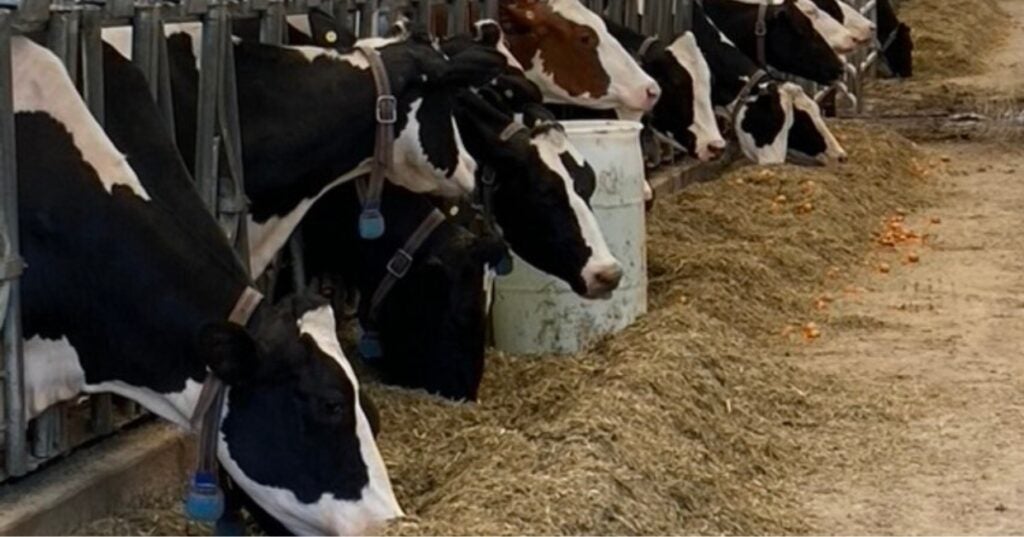
Food waste: Recycling, not discarding, offers huge environmental benefits (link is external)
Researchers at Penn Vet examine how common food waste recycling methods, including composting, could have a big impact on greenhouse gas emissions and the use of natural resources.
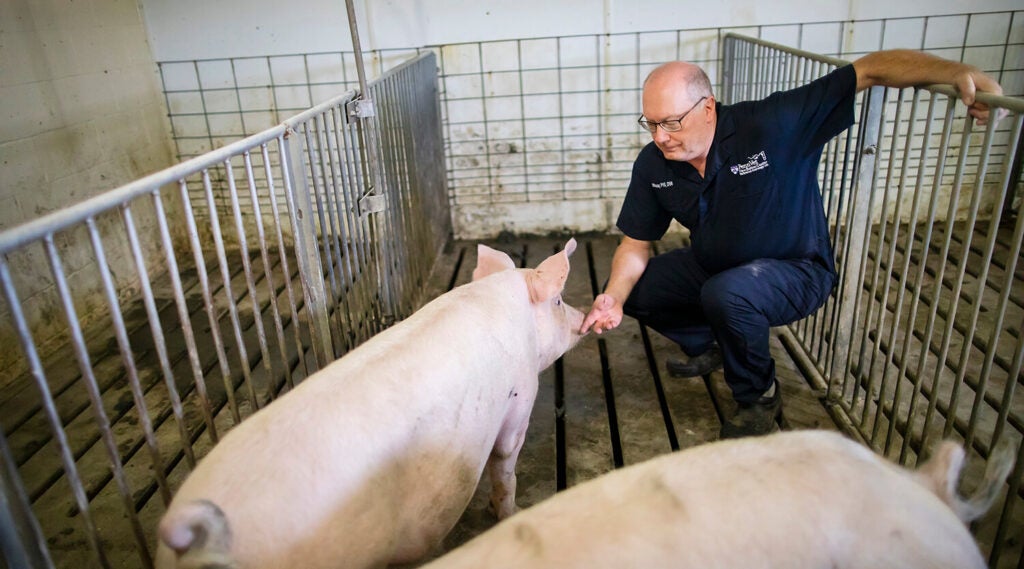
Supporting agriculture and a safe food supply (link is external)
Caring for a cow with uterine prolapse is not a task that a veterinarian can accomplish alone. The physicality and teamwork it demands makes it nearly impossible to sustain the…

Amazing Cows Hold Promise in Pioneering Sustainable Food Systems of the Future
In today’s climate change narrative, animal-based agriculture often endures criticism for its alleged contributions to the global problem. With some naysayers ranking the industry second only to the population explosion…